
What Is a Black Hole? Explained for Beginners
Black holes are among the most mysterious and fascinating objects in our universe. They are regions of space where gravity is so strong that nothing—not even light—can escape. While often depicted in science fiction as cosmic vacuum cleaners, black holes are far more complex and scientifically significant. In this article, we will explore what black holes are, how they form, and the extraordinary effects they have on space, time, and matter.
Understanding the Structure
A black hole is a region in space where the gravitational pull is so intense that nothing can escape from it. The event horizon marks the boundary around a black hole; once an object crosses this line, there is no return. At the very center lies the singularity, a point of effectively infinite density where the laws of physics as we currently understand them cease to function.
Black holes are generally categorized by their size and origin. Stellar black holes form from the collapse of massive stars and are usually 5 to 30 times the mass of our Sun. Intermediate black holes range from hundreds to thousands of solar masses, typically forming from the merger of smaller black holes. Finally, Supermassive black holes are found at the centers of most galaxies, containing masses equivalent to millions or even billions of Suns.
How Black Holes Form
Most black holes form when a massive star reaches the end of its life and runs out of nuclear fuel. Without the outward pressure from fusion reactions to counteract gravity, the star collapses under its own weight. If the remaining mass is high enough, the collapse continues until a singularity is created.
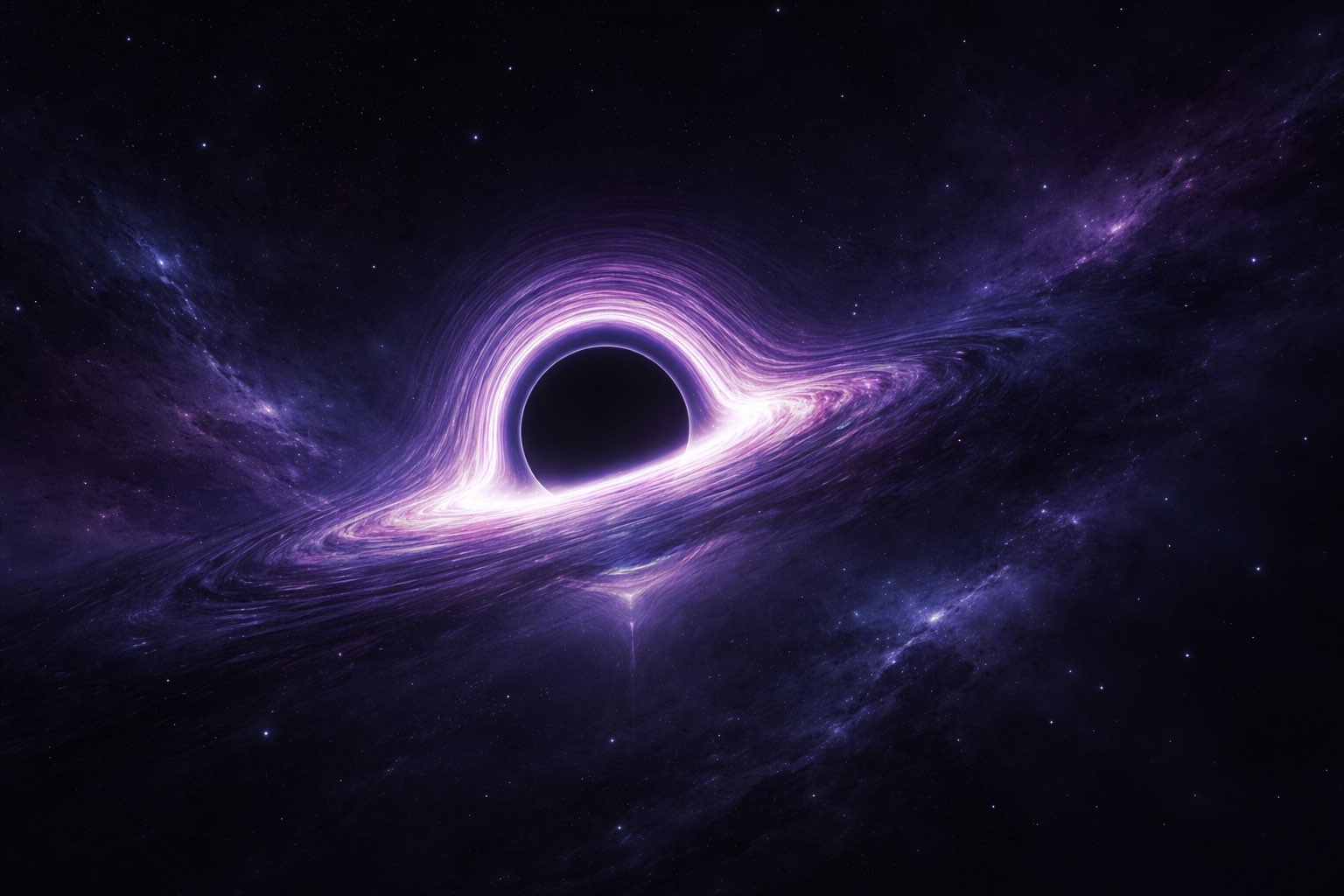
Beyond stellar death, black holes can also form through the collision of neutron stars or, in the early universe, from the direct collapse of massive gas clouds. This formation process dictates the black hole’s primary characteristics: its mass, its rotation (spin), and its surrounding features like an accretion disk—a swirling ring of superheated matter spiraling toward the horizon.
Distorting Space and Time
According to Einstein’s theory of general relativity, black holes dramatically warp the fabric of spacetime. One of the most mind-bending effects is time dilation. Because gravity is so extreme, time actually slows down near a black hole. To an outside observer, an object falling toward the event horizon would appear to slow down indefinitely, seemingly freezing in place before fading away.
Furthermore, the gravitational field is so powerful that it bends the path of light itself. This creates an effect known as gravitational lensing, where a black hole acts like a giant cosmic magnifying glass, distorting the images of stars and galaxies sitting far behind it.
How Astronomers Detect the Invisible
Since black holes emit no light, they cannot be seen directly. Instead, astronomers act as cosmic detectives, looking for the influence a black hole has on its surroundings. We detect them by observing the high-speed orbital motion of nearby stars, measuring X-ray emissions from superheated matter in accretion disks, and detecting gravitational waves—ripples in spacetime caused by the violent merger of two black holes.
Common Misconceptions
It is a common myth that black holes act like cosmic vacuum cleaners that “suck” in everything around them. In reality, gravity works the same way for a black hole as it does for a star. If our Sun were replaced by a black hole of the same mass, the Earth would continue to orbit it just as it does now—it would be very dark and cold, but we would not be “sucked” in. Additionally, black holes are not eternal; through a process called Hawking Radiation, they are predicted to slowly lose mass and evaporate over incredibly long timescales.
Conclusion
Black holes are not just scientific curiosities; they are essential to our understanding of the universe. They test the very limits of physics and influence how entire galaxies form and evolve. By studying these invisible giants, we gain a deeper appreciation for the complex laws that govern our cosmos.
To help you visualize the heavy, atmospheric nature of these cosmic voids, listen to our dark ambient track, Event Horizon, below.