
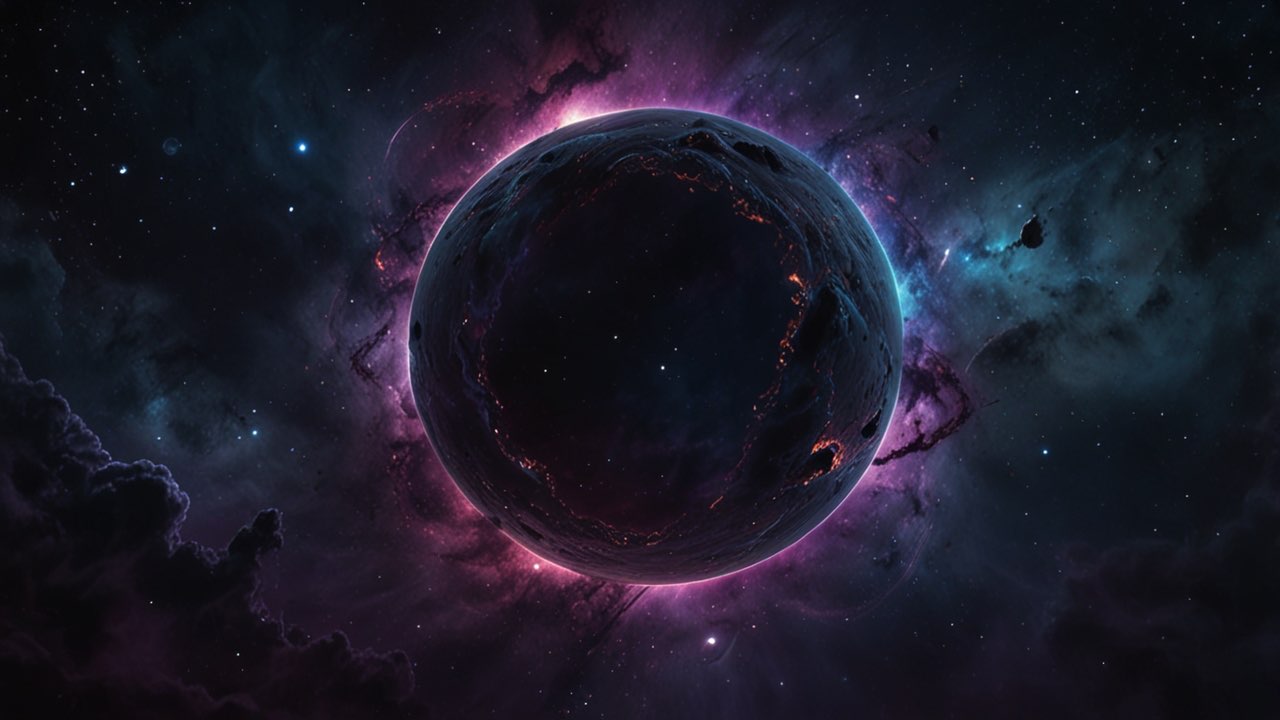
What Does a Black Hole Sound Like?
When you hear the phrase “black hole,” you probably imagine silence—an empty, lightless void. But in recent years, NASA has revealed something astonishing: black holes can be translated into sound.
Through a process called sonification, real astronomical data from space telescopes is converted into audio. The result is haunting, eerie, and strangely beautiful. These “cosmic sounds” are not science fiction—they are based on real signals from the universe.
In this article, you’ll learn:
- How NASA turns black hole data into sound
- What these sounds actually represent
- Why they feel so emotional and unsettling
- How they inspired modern dark ambient music
The Sound of Space
In 2022, NASA released audio based on data from the Chandra X-ray Observatory, the Hubble Space Telescope, and the Very Large Array. These sounds were created from images of galaxy clusters containing supermassive black holes.
Because sound cannot travel through the vacuum of space, black holes do not literally “make noise.” Instead, scientists map light, radiation, and pressure waves to sound frequencies. This technique is called sonification.
What Is Sonification?
Sonification is the process of turning scientific data into sound by assigning specific attributes to audio parameters. Scientists assign:
- Brightness to pitch
- Distance to volume
- Motion to tempo
So when you hear a rising tone or pulsing beat, you are listening to changes in radiation, matter, and gravity near a black hole. NASA used this method to convert real black hole observations into audio that humans can hear.
What Does a Black Hole Sound Like?
The result is often described as low-frequency drones, pulsing vibrations, echo-like waves, and deep mechanical tones. One of the most famous examples comes from the Perseus galaxy cluster, located over 250 million light-years away. Pressure waves moving through the cluster’s hot gas were shifted upward in frequency so humans could hear them. The sound is deep, eerie, and unsettling—like something ancient breathing in the dark.
Learn how black holes bend time and space in Black Holes and Time Dilation: How Gravity Warps Time.
Why Do These Sounds Feel So Emotional?
These tones trigger something primal in the human brain. Low frequencies are known to increase emotional intensity, create a sense of vastness, and trigger awe and unease. This is why black hole sonification feels both beautiful and terrifying. You’re not just hearing sound—you’re hearing gravity, collapse, and time itself translated into vibration.
The Connection to Dark Ambient Music
Dark ambient music often uses long drones, sub-bass frequencies, slow evolving textures, and minimal rhythm. These are the same qualities found in black hole sonification. That’s why so many dark ambient artists draw inspiration from space. The emotional resonance is natural—the universe itself becomes the instrument.
Our black hole tracks are designed to mirror these cosmic tones, creating an immersive experience that feels like drifting near an event horizon.
Explore the science behind the event horizon in Event Horizon Science: Where Time Stops.
How NASA Creates These Sounds
NASA scientists begin with telescope images. Each visual element is mapped to a sound parameter:
| Data Feature | Sound Mapping |
|---|---|
| Bright regions | Higher pitch |
| Dim regions | Lower pitch |
| Distance | Volume |
| Motion | Tempo |
| Radiation intensity | Tone texture |
The result is not random—it is a mathematical translation of reality.
Are These Sounds “Real”?
They are not sound waves traveling through space. They are accurate representations of data converted into sound so humans can perceive it. Think of them as audio graphs of gravity and radiation. This allows scientists to study patterns in new ways, identify structures, and understand black hole behavior more clearly.
Black Holes as Cosmic Instruments
Black holes interact with surrounding matter through accretion disks, jets of plasma, and gravitational waves. Each of these creates measurable patterns that can be translated into sound. When two black holes merge, detectors like LIGO record spacetime ripples. These ripples can also be converted into sound—creating short, rising “chirps” that mark the collision.
Why This Matters for Science
Sonification helps make space data accessible and reveals hidden patterns that the eye might miss. It engages the public emotionally and assists visually impaired scientists in “viewing” the cosmos. It also bridges the gap between science and art.
If you’re new to black holes, start here: What Is a Black Hole? Explained for Beginners.
Why It Matters for Ambient Music
These cosmic sounds prove that the universe already contains natural ambient music. Dark ambient artists simply translate cosmic emotion into musical form. Our tracks are built to feel like floating near a black hole, drifting through deep space, or standing on the edge of time. They are not just songs—they are environments.
Conclusion
Black holes do not scream or roar—but through sonification, we can hear their invisible forces. These sounds represent gravity, radiation, and time in motion. They remind us that the universe is not silent; it is singing in frequencies we are only beginning to understand.
Continue your journey: