
The Largest Black Holes Ever Discovered
Black holes exist in many sizes, but the largest of them grow so massive that they influence entire galaxies. These objects are known as supermassive black holes, and nearly every large galaxy in the universe contains one at its center. Their gravity shapes star formation, controls the flow of gas, and determines how galaxies evolve over billions of years.
In this article, we will explore the largest black holes ever discovered, how they formed, and why their size matters for understanding the structure of the universe.
What Makes a Black Hole “Supermassive”?
A supermassive black hole contains millions to billions of times the mass of the Sun. Unlike stellar black holes, which form from the collapse of massive stars, supermassive black holes grow by absorbing enormous amounts of gas and dust and by merging with other black holes during galaxy collisions. Over time, this steady growth turns them into the gravitational anchors of their host galaxies.
If you are new to black holes, you may want to start with What Is a Black Hole? Explained for Beginners before continuing.
TON 618: The Largest Known Black Hole
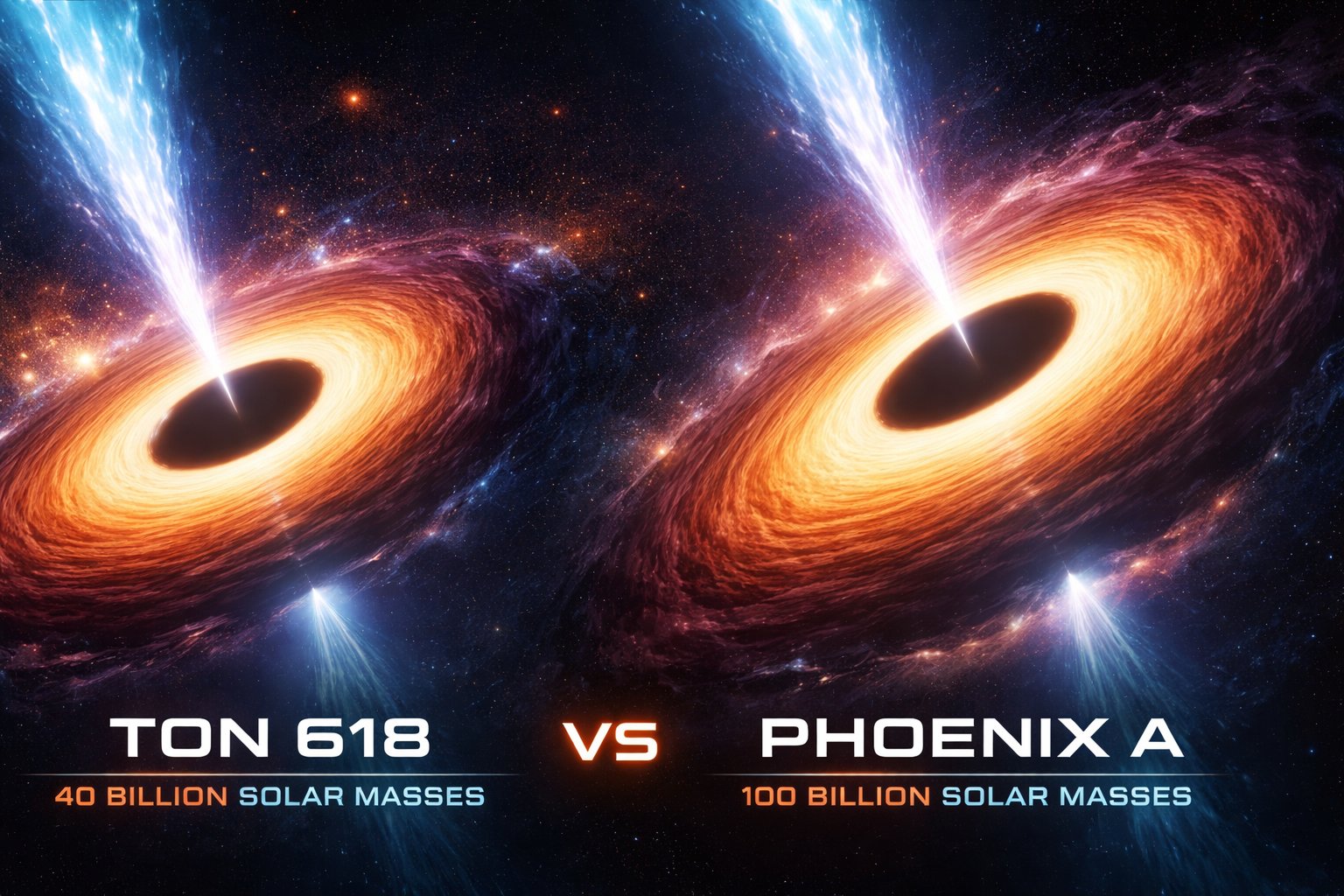
The largest confirmed black hole known to science is TON 618. It is located more than 10 billion light-years from Earth and is classified as a quasar, meaning it is actively feeding on surrounding matter. Its mass is estimated to be more than 66 billion times that of the Sun, making its event horizon larger than the orbit of Neptune.
TON 618 is so luminous because the material falling into it forms an accretion disk that releases enormous energy. This light can outshine entire galaxies, allowing astronomers to detect these extreme objects from across the universe.
Phoenix A: One of the Fastest Growing Giants
Another record-breaking black hole lies at the center of the Phoenix Cluster. This black hole is consuming matter at one of the fastest known rates, absorbing tens of solar masses each year. Its mass is estimated to be over 100 billion times that of the Sun, although precise measurements are still ongoing.
The energy released by Phoenix A is powerful enough to heat the surrounding galaxy cluster, preventing new stars from forming. This shows how black holes regulate the growth of galaxies on the largest scales.
Sagittarius A*: The Black Hole at the Center of the Milky Way
At the center of our own galaxy lies Sagittarius A*, a supermassive black hole with a mass of about four million Suns. Although it is small compared to giants like TON 618, its proximity makes it one of the most studied black holes in the universe.
In 2022, astronomers captured the first direct image of Sagittarius A*, confirming decades of research and observations. This discovery proved that supermassive black holes truly exist at the centers of galaxies.
How Do Supermassive Black Holes Form?
Scientists believe these giants formed very early in the universe’s history. Some may have originated from the direct collapse of massive gas clouds, while others grew rapidly through mergers and accretion. Over billions of years, these black holes became the central engines of galaxies.
To understand what happens near their boundaries, read Event Horizon Science: Where Time Stops.
How They Shape Galaxies
Supermassive black holes are not passive objects. Their gravity and energy output control how galaxies evolve. When they feed, they release jets and radiation that can heat or push away gas, stopping new stars from forming. When they are quiet, galaxies may grow and form stars more easily.
These feedback cycles explain why galaxies and their central black holes grow together.
Time and Gravity Near Massive Black Holes
The larger the black hole, the stronger the warping of spacetime around it. Time passes more slowly near massive black holes, an effect predicted by Einstein’s theory of relativity. This phenomenon becomes extreme near the event horizon.
You can explore this further in Black Holes and Time Dilation: How Gravity Warps Time.
Why These Giants Matter
Studying the largest black holes helps scientists understand the early universe, the formation of galaxies, and the limits of physics. These objects represent the most extreme environments known and challenge our understanding of space, time, and gravity.
Conclusion
The largest black holes are not just massive objects hidden in space. They are the architects of galaxies, shaping the universe on the grandest scales. From TON 618 to Sagittarius A*, these giants remind us that gravity is one of the most powerful forces in existence.
Continue the cluster with Event Horizon Science: Where Time Stops.